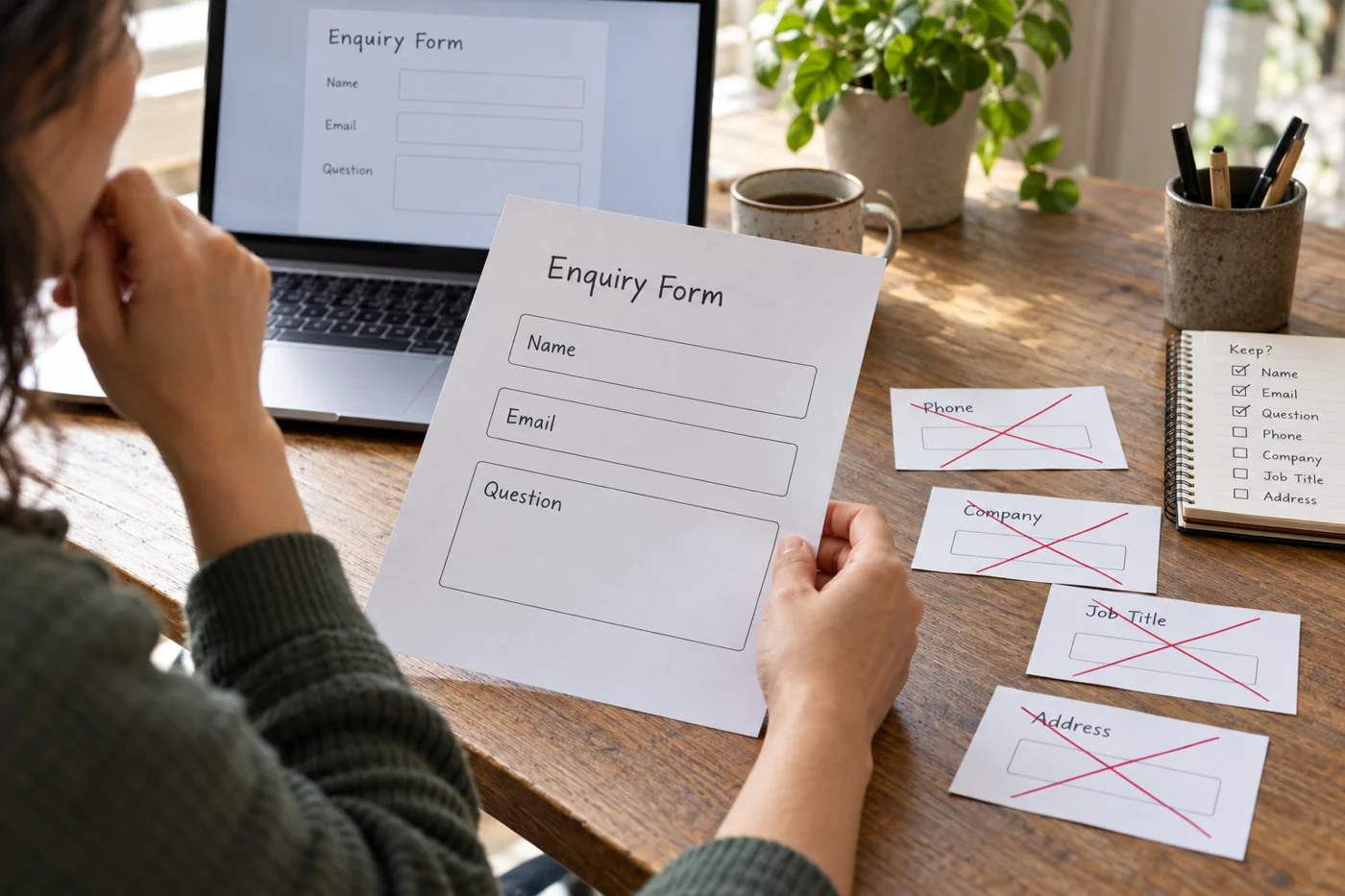
Collect questions from everyday work
Record recurring questions over a manageable period. Remove names and other details unnecessary for the review. Group similar issues by meaning rather than identical wording. “Which documents should I send?” and “What do you need before the appointment?” may reflect the same information gap.
Notice when the question arises. Somebody booking needs different information from somebody who has received a delivery. An FAQ that mixes all stages without order makes visitors search again. A small thematic group near the relevant action can work better than one large central list.
Repair the main information first
If almost everybody asks where to book, the booking route probably needs greater clarity on the relevant page. Another FAQ answer alone will not solve the discovery problem. Similarly, an important limitation should not appear only inside a collapsed question.
An FAQ suits supplementary distinctions and common exceptions. The main page might describe the normal process while a question explains what is possible with incomplete documents. The two explanations must agree.
Begin with the answer
Answer the question in the first sentence, then explain the conditions. For a preparation question, name the documents actually needed and explain which information can follow later. Avoid a long general introduction about the importance of preparation.
Label the next-step link clearly. “Change an appointment” is more useful than “click here”. If the answer depends on a particular service, show that limitation. A blanket answer that applies to only part of the offering creates new questions.
Turn a recurring question into a checkable answer
Three customers ask whether they must upload documents before an appointment. That does not yet produce an answer suitable for every booking. First establish which appointment type actually requires those documents and whether later submission remains possible. State the condition directly: “For a document review, we need the agreed files before the appointment; an initial orientation conversation does not require them yet.” Use only conditions that match your own process.
Show the draft to someone who does not handle that workflow. Can they now decide whether to upload anything and where their next step begins? If they still have to ask, a condition or a clear link is probably missing. A longer answer is not automatically more useful.
Assign a review trigger to the entry, such as a change to appointment types or the upload method. The answer can then be updated when its underlying process changes, rather than waiting for an arbitrary date on a calendar.
Keep learning from actual inquiries
After publication, notice which questions still arrive. Having an answer does not mean it is found or understood. Check its wording, position and linked route before continually making it longer.
Remove or revise answers when the process changes. Record internally who reviews the content. A short, current FAQ with clear limits is more useful than an extensive collection of old promises whose validity nobody can assess.