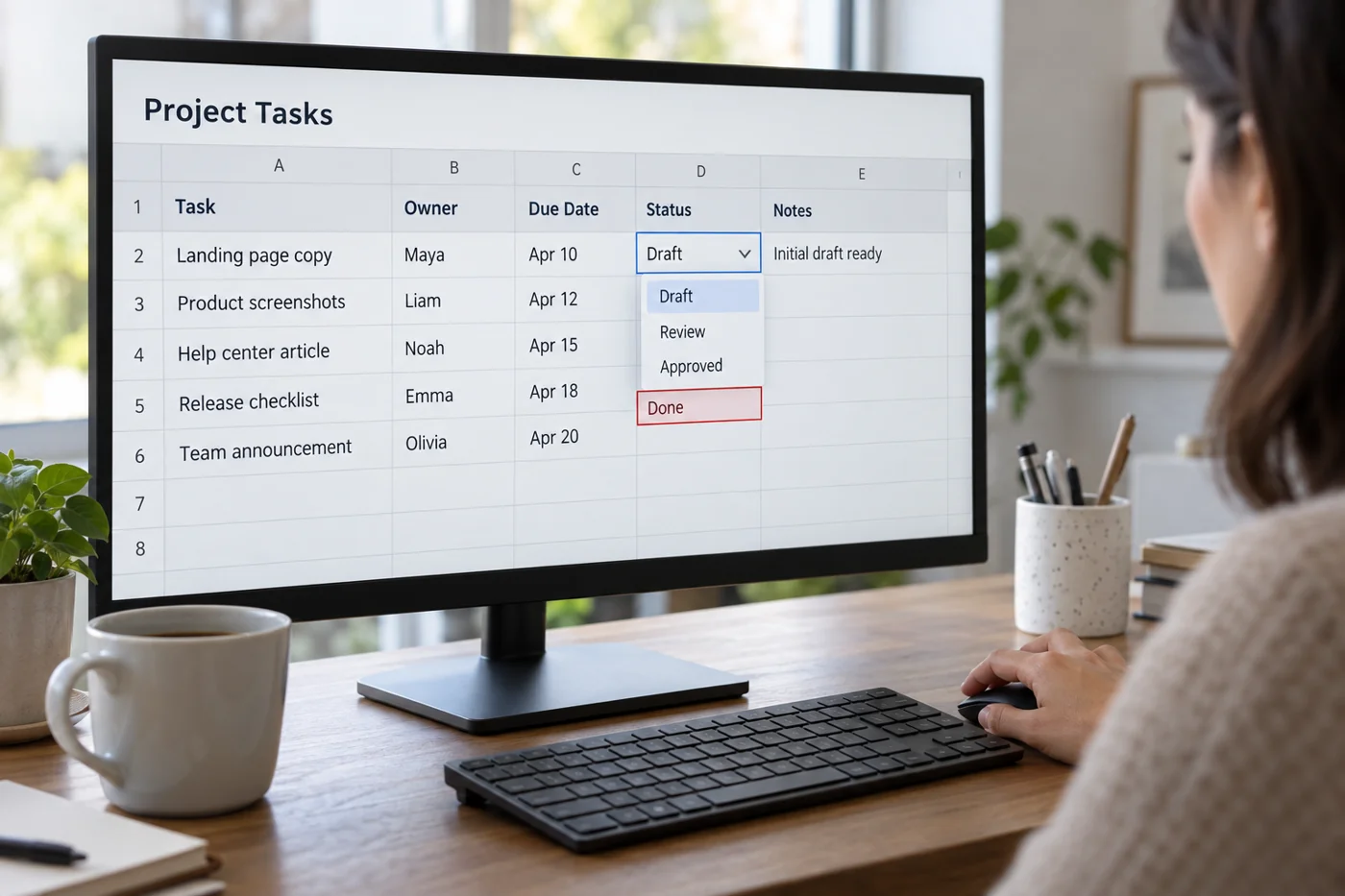
Define what one row represents
Decide whether a row represents a request, a work package or a location, for example. Do not casually mix these levels. If one request contains several work packages, use a clear relationship or separate views with an understandable connection.
Give records a stable identifier when they must be recognized later. A changing row position is unsuitable for that purpose. Also describe when to create a new row and when to update an existing one. This reduces duplicate records when people provide repeated updates.
Explain fields with examples
Use understandable column names and explain ambiguous terms. Agreed status values such as “open”, “in progress” and “complete” can be sufficient when their boundaries are defined. A separate notes field can hold exceptions without changing the status vocabulary.
Distinguish missing information from deliberately unknown or inapplicable values. A blank date might otherwise mean either “not planned yet” or “forgotten”. Choose an agreed convention appropriate to the field and make the rule visible to everyone maintaining it.
Separate entry from calculation
Identify areas maintained by people and areas that calculate results. Where the application offers suitable features, dropdown choices or input checks may help. Test them with ordinary and incorrect examples; they do not replace understandable rules.
Agree how sorting and filtering should be used. Related values must remain together as a record, and nobody should interpret a filtered view as evidence that other records do not exist. Explain the agreed approach instead of assuming that everyone has the same knowledge.
Arrange everyday maintenance
Assign responsibility for entries, questions and changes to the structure. A proposed column should have a specific purpose. After a short period of use, inspect a few real records together. Are their status, date and ownership clear enough for another person to identify the next action?
If not, improve the meaning of the fields first. Extra colors rarely resolve conceptual ambiguity. A smaller sheet with dependable entries is often more useful for collaboration than a larger collection whose fields mean different things to different contributors. Record significant definition changes so that older rows can be interpreted correctly rather than silently applying a new meaning to historical information.
Complete an example row together
Take a concrete request: one team needs an updated room overview by the end of the month. Ask two people to complete an example row independently. If one enters the arrival date and the other the required completion date, the ambiguity becomes visible immediately. Rename the field “required completion” and add a separate arrival date only if it is actually needed.
Then examine status. “In progress” should not merely mean that somebody has read the request. You might define it as an assigned person having accepted the task and begun work. If input is missing, make that visible without losing the original assignment from the overview.
Test exceptions too. What happens when a request is withdrawn, divided into two tasks or reopened after completion? Not every possibility needs a separate column. A clear status rule and short change note are often sufficient. What matters is preserving the original meaning of the record.
Control structural changes
Before introducing a required field, discuss who can provide it and how it will be used. Information that nobody reliably knows encourages guessed entries. If it becomes available only later, the sheet needs to accommodate that state.
When calculations change, check known examples against expected results. A sheet can look unchanged while a revised formula produces different conclusions. Keep those changes traceable and inform the people using the outputs. Maintaining the structure is a responsibility in its own right; it should not be redefined casually with each data entry. For a frequently used sheet, identify a convenient way to report structural problems without inviting every contributor to make incompatible changes independently.