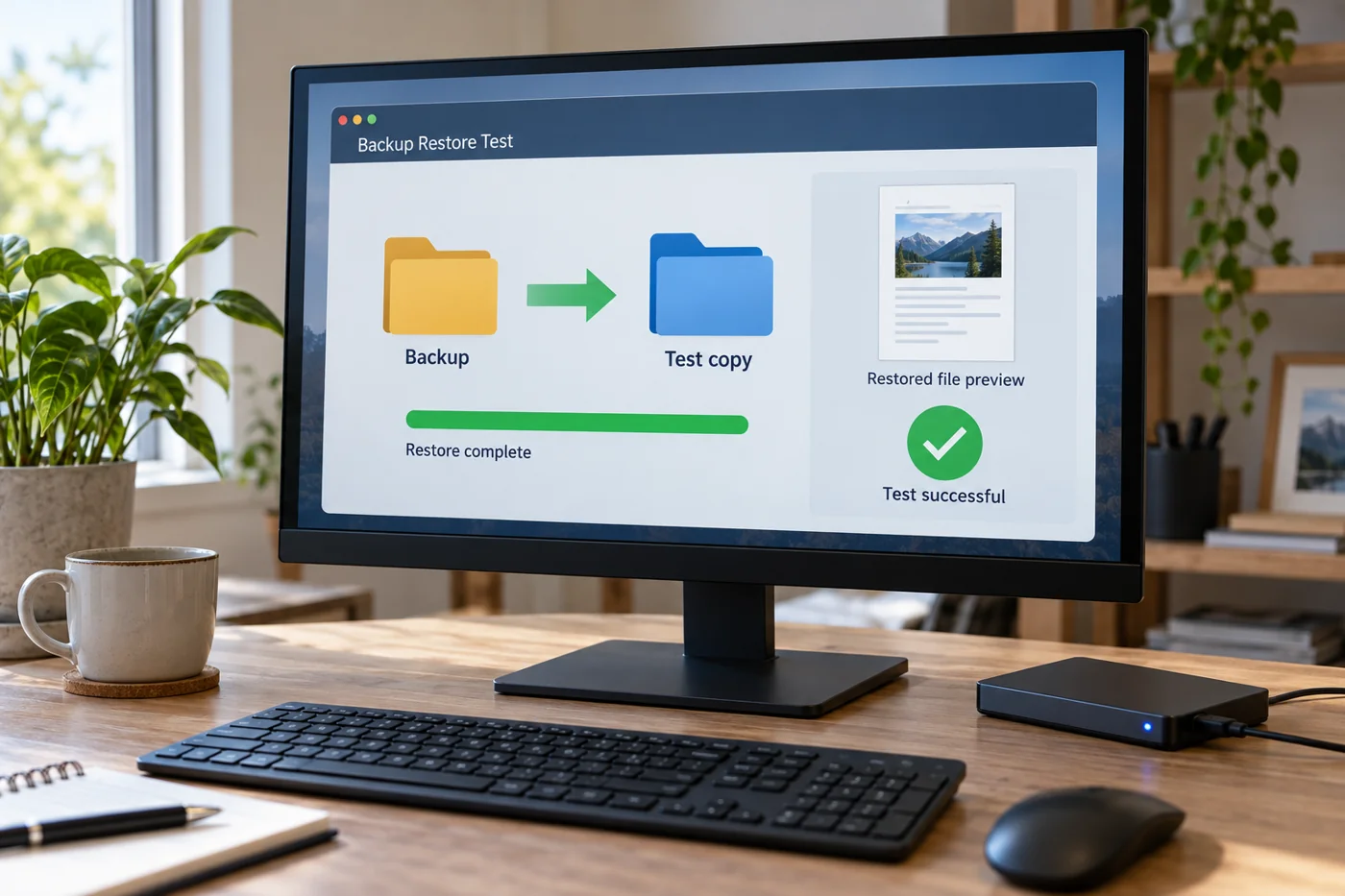
Identify what is actually needed
A static website may consist of delivered HTML and resources. A publishing system may additionally need a database, uploaded media and configuration. WordPress explicitly identifies files and database as complementary backup components. Do not transfer that example blindly to every system; establish your own site's architecture.
Record dependencies outside the website folder too. A contact form may use an external sending service, and login may depend on another provider. Backing up page content does not automatically recreate access to those services. Describe what reconnection requires and where that information remains available through controlled access.
Select a usable backup state
Choose one existing backup and record its date and documented scope. Check whether related components belong to a compatible state. An old database paired with later changed files may have different prerequisites from a coordinated snapshot. Resolve uncertainty through the actual backup procedure.
Check access independently of the running website. If the only route to backups depends on the system that has failed, recovery is constrained. Verify required accounts and recovery information without copying passwords into a general project table. Accessibility here means controlled access that genuinely works.
Prepare a separate test environment
Identify an environment where restoration is authorized. It should not accidentally replace public content or send real messages. If test data includes personal or confidential information, access and handling need appropriate controls. Use prepared test routes rather than triggering real customer processes.
Document the test environment's starting state. This distinguishes restored material from anything already present. Follow the system's or provider's intended recovery procedure. An improvised mixture of files may appear functional without actually testing the documented return path.
Inspect more than the homepage
After restoration, check several page types, images and downloads. For a CMS, login and a harmless test edit in the separate environment may belong to the scope. A loaded homepage does not establish that older media, internal links or dynamic functions are available.
Compare known content with the selected backup date. An article created afterwards can legitimately be absent. An article already present beforehand should not disappear without explanation. Record the expected point in time so that this distinction remains visible.
Test forms only through prepared test recipients. Confirm whether configuration and sending routes could be reconnected. State the limitation when external functions were not tested. A restored interface is not equivalent to fully resumed operation.
Record effort and missing steps
Capture the actual steps and approximate time required. Include finding access details or waiting for provider assistance. A quick file copy may represent only a small portion of restarting service. This observation helps determine whether the planned recovery route fits organisational needs.
Turn missing information into concrete tasks: an unclear database export, undocumented configuration or unreachable responsible person. Assign ownership and repeat affected steps after correction. A long list of unresolved observations is not yet a successful test.
Describe the result within its scope
Keep backup identifier, test environment, checked functions and remaining limitations together. State whether complete operation or only selected content was restored. Another person can then judge what the evidence establishes.
Repeat testing after substantial system changes or at an appropriate interval. A recovery path that worked long ago may become incomplete through new dependencies. The backup then remains more than a file: it is a tested procedure with known prerequisites. Keep the original backup protected during the exercise and distinguish test copies clearly, so that verification itself does not consume or confuse the recovery material you intend to retain.