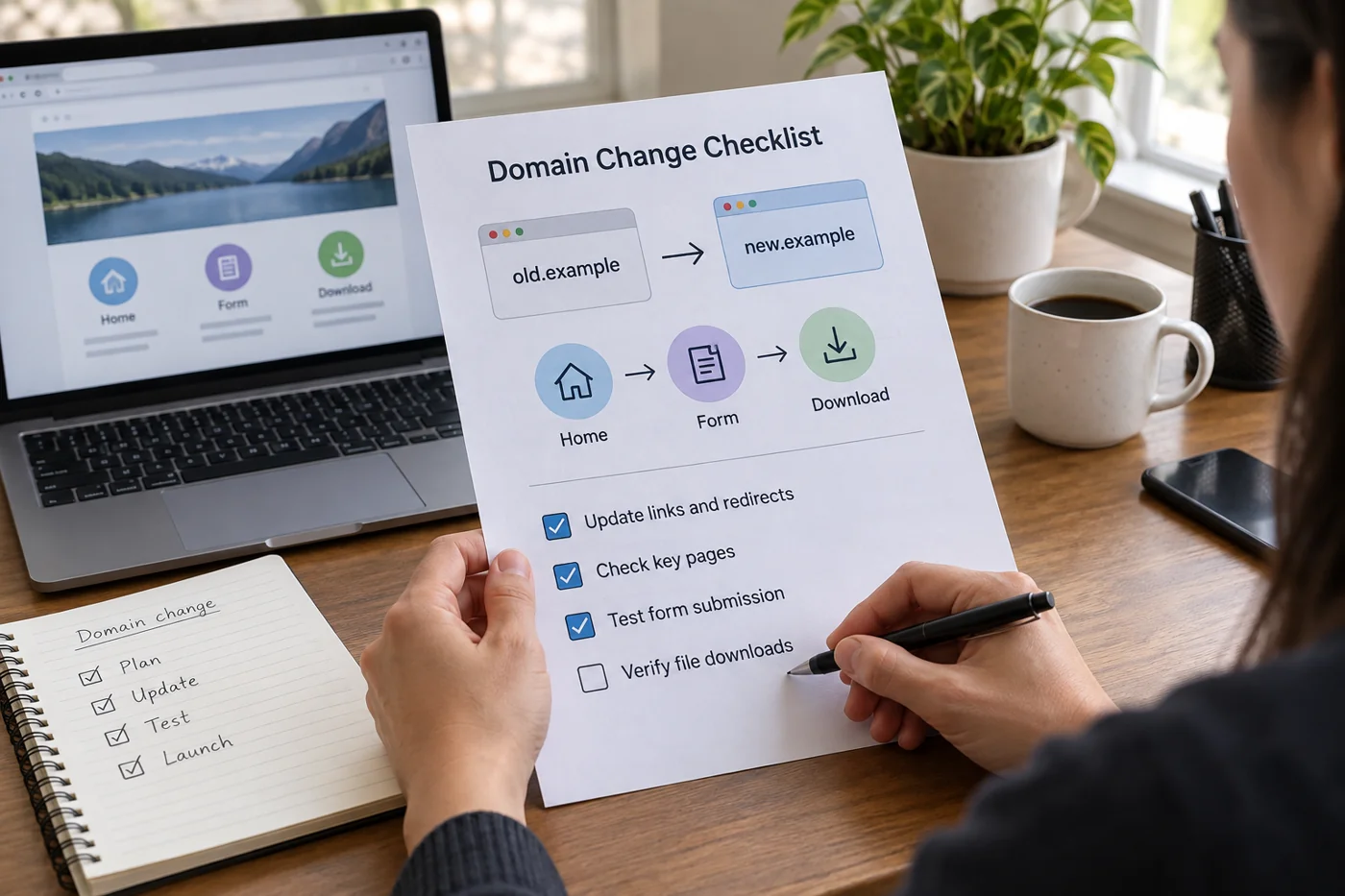
Keep the starting addresses before the move
List important old URLs alongside their intended new destinations. Begin with frequently needed service pages, contact routes and downloads. Add pages referenced in printed material or offers already sent. Visitors using those entry points may have no way to work out the replacement address themselves.
Mark content whose path is changing too. Merely replacing the domain name will not locate those pages. An old address for a particular consultation should lead to its corresponding new service page rather than automatically going to the homepage. Have the content owner confirm that mapping before redirects are configured.
Open old entry points individually
After the change, open selected old addresses directly. Observe the final URL and the content actually displayed. A familiar-looking page may still be on the old server. Conversely, the new address may appear correctly while opening the wrong language or a general overview instead of the intended page.
Google recommends direct redirects to the final destination rather than unnecessary redirect chains during site moves. For your journey review, record the starting and ending addresses and have unclear intermediate steps investigated. Do not infer a technical diagnosis from a visible browser transition; checking status codes and the chain requires an appropriate technical inspection.
Complete an inquiry journey
Follow a service page through to its intended contact method. Use clearly labeled test information for a form submission and agree the test with the person receiving it. A confirmation on the website does not establish that the message reached the right destination. Check actual delivery and, where relevant, the address used for a reply.
Review embedded services separately. A booking window may load while its return link still points to the old domain. Carry out agreed test steps and avoid making real bookings or payments merely to inspect the screen. Record which stages you verified and which need a dedicated test environment or further authorisation.
Include files, images and language pairs
Open a download through the new site and through a known old direct link. Compare the downloaded edition with the intended file. Check images on representative pages, including an inner page with a different layout. A working homepage illustration says nothing about files stored deeper in the directory structure.
On a multilingual site, change language on several inner pages. Check that both directions stay with the matching translation and use the new domain. A global language-menu change may look correct on the homepage while sending every article to the same destination. Deliberately choose different page types for this test.
Update references and technical declarations
Review contact templates, email signatures and important documents displaying the web address. Change references you manage yourself. Put third-party listings into a separate list so someone can make specific update requests. Not every external link is immediately within your control, and recording that distinction helps avoid losing track of outstanding work.
Have technical declarations such as sitemap and canonical URLs checked against the intended domain. This belongs in technical acceptance; visible text alone does not cover it. If the website and email share a domain, treat email checks as a separate workstream. A reachable website does not prove that mail is being delivered.
Close with a list of remaining problems
Rank faults by their effect: a broken inquiry route is more urgent than an old domain mentioned in a rarely read archive. For each issue, record the URL, observed sequence, responsible person and next check. Close it only after repeating the original test successfully.
Keep the old-entry list. When someone reports a problem later, it shows whether the route was checked or lay outside your sample. Describe acceptance just as specifically: name the page types and functions tested instead of claiming that everything works after the move. This gives the next person a clear starting point for further investigation.