Choose one comparison basis
Establish how many people need the application and which capabilities are essential. Compare one sufficiently equipped plan with another sufficiently equipped plan. A cheap entry tier lacking required export or administration functions is not an equivalent option for this purpose.
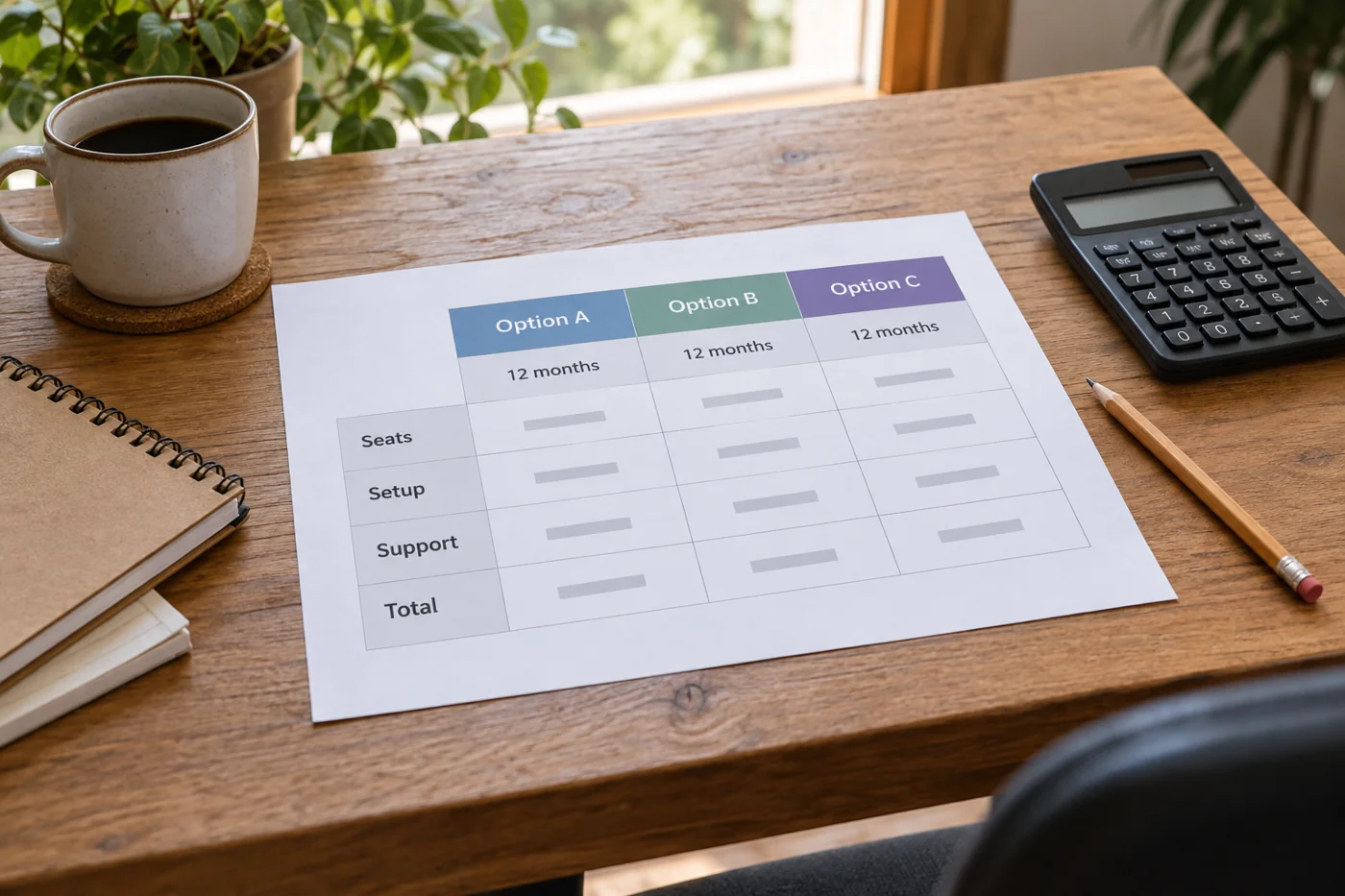
Use the same period, such as twelve months, and the same currency. Identify whether tax is included and whether currency conversion was used. Do not combine differently presented prices without exposing those differences.
Record when the research happened and the source of each figure. Prices and plan limits change. A comparison with documented assumptions can be updated later; an isolated number without a source is harder to maintain.
Separate monthly equivalents from payment
An annual price displayed as a monthly equivalent may require payment upfront. Show when payment would occur alongside the calculated cost. These answer different questions: what does the period cost, and when is each amount paid?
Do not silently extend a temporary discount across the whole period. Separate introductory and subsequent prices where both are known. If a later amount is uncertain, mark that uncertainty instead of inventing a favorable figure.
A fictional calculation
Suppose tool A costs an equivalent twelve euros per person per month when paid annually. Four required seats would cost 576 euros for twelve months. Tool B costs fifteen euros per person with monthly payment in this example, or 720 euros across the same period. These are illustrative numbers, not market prices.
The comparison is not complete yet. If A also requires a one-time setup costing 180 euros, its first period totals 756 euros. That one-time item may not recur in the following year. Show first-year and later-year costs separately when the distinction matters.
If B provides a required capability only on another plan, use that plan’s actual price. Comparing the wrong tiers can be mathematically correct while still preparing the wrong decision.
Record effort as a separate assumption
Setup, data transfer and training take time. Record those hours separately without necessarily assigning a monetary value. If you apply an internal hourly rate, identify it as your assumption and use it consistently.
Separate one-time switching effort from recurring administration. Complex setup may lead to stable operation; quick setup may require continual manual correction. Test these assumptions during a trial instead of deriving them solely from product descriptions.
Also record possible extras such as necessary storage, additional seats or expressly required integrations. Include only items relevant to your working case and traceable to current information.
Recalculate a different seat count
Add a second calculation if team size may realistically change. Plans with a minimum seat count can behave differently at four and six required users. Use the product’s actual billing logic and label the second calculation as a scenario.
Apply the same approach to usage-based items. If costs depend on completed operations, choose a justified volume from real work. An arbitrarily low number makes the comparison cheaper-looking rather than more useful.
Show which assumption changes the result most strongly. Participants then know which information needs closer checking before a decision. There is no need to calculate every remote possibility in an enormous spreadsheet.
Do not reduce the choice to one number
Put costs beside requirements met and limits observed. A cheaper tool may suit the work; a more expensive one may enable a decisive step. The comparison should expose that trade-off rather than conceal it behind an apparently objective total score.
Check the actual terms again before ordering. The table supports a decision using documented assumptions; it does not guarantee a permanently valid price. Record which details need checking again before the next renewal.